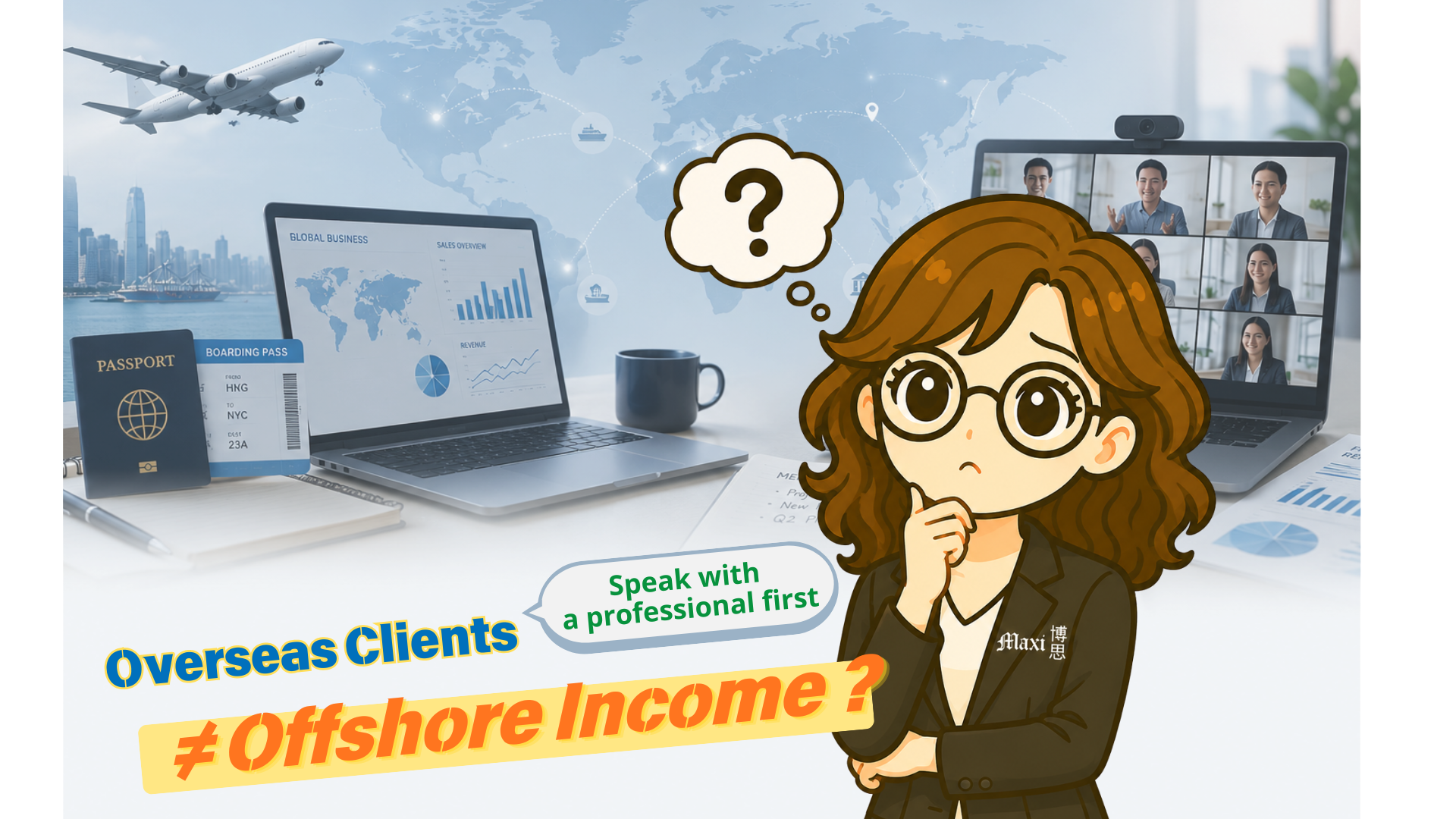
Overseas Clients ≠ Offshore Income?|Cross-border Tax Arrangements Require Professional Support

After the pandemic, more companies have started handling overseas business online.
In the past, businesses might have needed to travel overseas for client meetings, contract signing, and business discussions.
Today, many business operations can be completed with just a computer.
As a result, more businesses are beginning to consider:
• Setting up offshore companies
• Managing overseas payment arrangements
• Expanding cross-border business
• Adjusting overseas operating structures
• Handling cross-border tax arrangements in a legal and compliant manner
Especially for companies involving overseas clients, overseas business, e-commerce, or remote work, business operations today are very different from before.
Because of this, more businesses are seeking professional support for offshore company setup and cross-border tax arrangements, hoping to better support overseas business development while reducing unnecessary tax and operational risks.
However, many people assume that:
having overseas clients automatically means the income qualifies as offshore income.
In reality, it is not that simple.
The tax authority will usually assess multiple factors, including:
where the business is actually managed, operated, and where the income is generated.
This time, Maxi’s Amy will explain several key points in the simplest way:
- Does Offshore Income Depend Only on Client Location?
- What Do Tax Authorities Usually Review?
- What Should Companies Prepare Before Applying for Offshore Income Claims?
Does Offshore Income Depend Only on Client Location?
Many people believe that as long as the clients are overseas and payments are received from overseas companies, the income automatically qualifies as offshore income.
In reality, tax authorities do not only look at the client’s location.
Especially after the pandemic, more businesses have started handling overseas operations through Zoom, email, and online systems.
Today, many business processes can be completed entirely online.
As a result, tax authorities will usually review factors such as:
• Where the business operations are actually carried out
• Where decisions are made
• Where contracts are negotiated
• How the income is generated
In other words, even if a company does not have a physical office or fixed assets in Hong Kong, if part of the business activities are conducted in Hong Kong, it may still affect the offshore income assessment.
What Do Tax Authorities Usually Review?
1. Are There Overseas Tax Filing Records?
If the related income has already been taxed overseas, tax payment documents are usually required to keep as supporting.
This helps tax authorities assess whether the income genuinely originates overseas.
2. What Is the Company’s Main Source of Income?
The income description in the audited financial statements should generally match the company’s offshore business activities.
If a company applies for offshore income treatment but the business description conflicts with the actual operating model, it may increase the risk of further enquiries.
Therefore, having clear and properly prepared audited financial statements is very important.
In addition, if a business is considering setting up an offshore company, its business model, income sources, and operational arrangements should also be clearly organized in advance.
3. Where Are the Business Activities Actually Conducted?
Even if a company does not have a Hong Kong office or fixed assets, if directors or employees regularly work in Hong Kong and handle company operations there, it may affect the income source assessment.
As online meetings become increasingly common, tax authorities may still regard certain business activities as being conducted in Hong Kong, even without physical meetings.
4. Does the Company Use a Hong Kong Bank Account?
If the company uses Hong Kong bank accounts, additional explanations regarding the account usage may sometimes be required.
In certain cases, tax authorities may further assess whether the business has substantial connections with Hong Kong.
What Should Companies Prepare Before Applying for Offshore Income Claims?
If the company involves:
✔ Overseas clients
✔ Online meetings
✔ Remote work
✔ Overseas business
It is advisable to organize the following in advance:
• Business workflow and operating process
• Income source records
• Contracts and meeting records
• Supporting documents for overseas business activities
If the company is also considering setting up an offshore company, it is important to organize:
• Business operating structure
• Overseas business workflow
• Income sources
• Cross-border payment arrangements
The earlier these are properly organized, the easier future tax enquiries can usually be handled.
💡 Amy’s Tips
More businesses today are using offshore companies to handle overseas business and cross-border income.
However, setting up an offshore company is not simply a matter of incorporation. It should be supported by proper business operations, company structure, and documentation in order to handle cross-border tax arrangements effectively and compliantly.
As a result, many businesses seek professional assistance for:
✔ Offshore company setup
✔ Overseas business structure planning
✔ Cross-border tax planning
✔ Overseas payment arrangements
This helps businesses support overseas expansion while handling cross-border arrangements legally and more tax-efficiently.
Thinking About Setting Up an Offshore Company? Speak with Amy First
Amy from Maxi can help you:
✔ Set up offshore companies
✔ Assess whether your current business is suitable for offshore arrangements
✔ Analyze your existing business model
✔ Organize cross-border business and income information
✔ Provide guidance on compliant tax arrangements
✔ Assist with company and document preparation
This allows you to better understand whether your current arrangements are suitable and what preparations may be needed next.
👉 For enquiries about overseas clients, cross-border operations, or offshore company arrangements, click here to contact us.
WhatsApp / WeChat: (852) 5236 2580
☎️ Enquiry Hotline: 2761 0139
🔔 To receive regular updates on accounting, taxation, and company compliance matters, follow our Facebook page: https://www.facebook.com/maxiconsultant/
#OffshoreCompany #OffshoreIncome #CrossBorderTaxation #OverseasClients #BusinessGrowth #StartupEssentials #StartupTips #TaxTips #AccountantLife #CPA#tax #accounting #Maxi #limited company #unlimited company #MaxiAmy