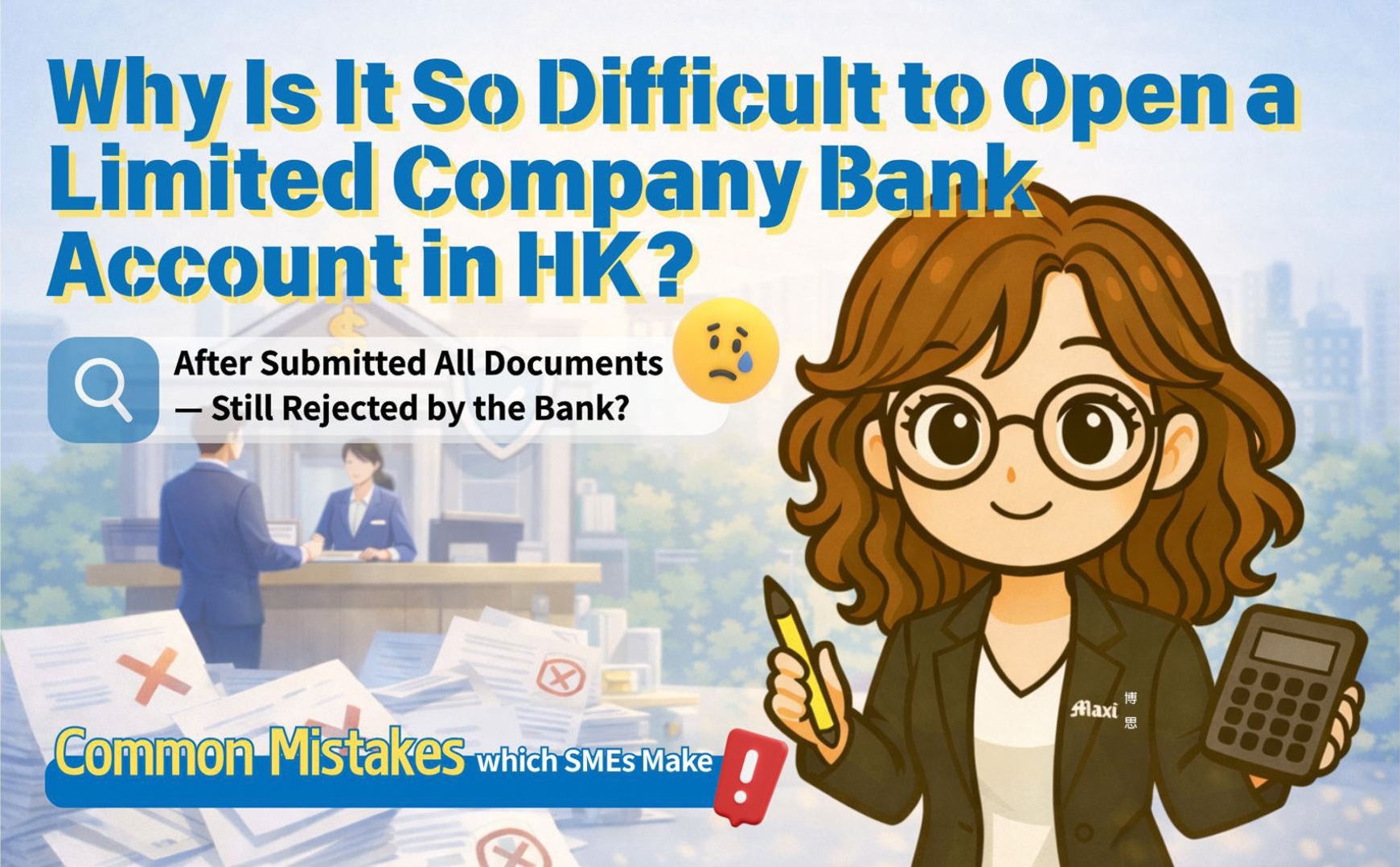
Why Is It So Hard to Open a Company Bank Account? Common Reasons Applications Get Rejected

Many small and medium-sized business owners in Hong Kong believe that opening a limited company bank account is simply a matter of preparing the required documents listed online.
After searching “documents required to open a company bank account in Hong Kong,” it often appears that only a few basic items are needed. As a result, many founders assume that once everything is prepared according to the checklist, the application will be approved smoothly.
However, in practice, opening a bank account for a limited company is often far more difficult than expected. In recent years, banks have tightened their approval standards significantly. Even when all documents are complete, applications may still be rejected if the business operations or source of funds cannot be clearly explained.
In addition, most banks allow only one formal application opportunity per company. If the first application fails, the rejection record is usually retained, making future applications with the same bank much more difficult.
Now, let our colleague, Amy, from Maxi-Solution Accounting and Taxation Limited Walk You Through It:
Contents
- What documents are generally required to open a limited company bank account?
- Why can a bank account application still be rejected even when all documents are submitted?
- What do banks really focus on when approving a company bank account?
- Why do limited companies usually have only one formal application opportunity?
- Professional advice: How to reduce the risk of having your company bank account application rejected?
What Documents Are Usually Required to Open a Limited Company Bank Account?
In practice, banks usually review close to 9 categories of information, while most business owners are only able to prepare around 4 basic documents on their own.
In general, the basic documents most SMEs commonly prepare include:
- Certificate of Incorporation
- Business Registration Certificate
- Identification documents of directors and shareholders
- Company structure documents, such as the Articles of Association (AA) and Significant Controllers Register (SCR)
These documents are mainly used by banks to verify the basic information of the company and its related parties. Once submitted, banks will usually proceed with an initial review.
However, these documents alone are often not the main factor determining whether the account application will be approved.
The following information is usually what banks pay closer attention to and where problems are more likely to arise:
5. Explanation of the company’s business background and actual operations
6. Description of the business nature and transaction model
7. Background information of directors and shareholders
8. Source of funds and expected fund flow arrangements
9. Expected customer types, transaction amounts, and responses during bank interviews
These are not documents that can simply be “submitted and completed.” Instead, they are important factors banks use to assess whether the company’s business is reasonable, whether the information provided is clear, and the overall risk level of the company.
With assistance from Maxi Amy, these additional areas can also be properly prepared and organized, allowing the overall bank account opening process to be more complete.
💡 Amy from Maxi-Solution Accounting and Taxation Limited reminds you:
Many SME owners underestimate the importance of explaining their business background and source of funds. In reality, these are often the key areas banks focus on most during approval.
Why Can a Bank Account Still Be Rejected Even When All Documents Are Submitted?
The reason is simple: banks are not only reviewing documents, they are assessing the business’s feasibility and legality.
If a company cannot clearly explain its operations, source of funds, or management background, or if the explanations are inconsistent, banks may consider the application high risk.
Common reasons for rejection include:
- Business activities described too vaguely
- Directors’ or shareholders’ backgrounds not matching the stated business
- Unclear or illogical explanation of fund sources and usage
- Inconsistencies between written documents and interview responses
From the bank’s perspective, opening a company bank account is not just a formality. It is a risk assessment process that must comply with regulatory and compliance requirements.
What Do Banks Really Focus on When Reviewing Limited Company Bank Accounts?
Contrary to common belief, banks are not primarily concerned with whether your company has sufficient capital at the time of application.
Instead, banks want to understand one key question:
Is the business legal, reasonable, and operated by people with appropriate knowledge or background?
Banks generally focus on the following areas:
1. Is the Business Legal and Properly Regulated?
Banks first confirm whether the declared business activity is legal and compliant.
If the industry requires specific licences or professional qualifications, the company must be able to explain how these requirements are met.
For example, if a company applies to open a bank account for providing medical services, but the director does not hold any relevant medical qualifications or licences, the application is very likely to be rejected.
On the other hand, if a professional operates a business within their qualified field, banks are far more comfortable approving the account.
2. Do the Directors Have Relevant Knowledge or Experience?
Banks do not expect every business owner to be an industry expert. However, they do expect directors and shareholders to demonstrate a basic understanding of how the business operates, including services provided, transaction processes, and daily operations.
If the declared business has no clear connection to the directors’ background, and no reasonable explanation is provided, banks may question whether the company can operate legitimately.
3. Are the Explanations Consistent?
Banks compare written submissions with interview responses.
If explanations change, become unclear, or contradict earlier statements, the perceived risk level increases.
In short, banks are not assessing how much money you have. They are assessing whether your business makes sense.
💡 Amy from Maxi-Solution Accounting and Taxation Limited reminds you:
Industry qualifications, licences, and relevant background often matter more than having complete documents. Documents are only the first step. The overall business logic is what truly affects approval.
Why Is There Usually Only One Formal Application Opportunity?
Once a limited company formally applies for a bank account, the submitted information and approval outcome are recorded by the bank.
If the application is rejected, that record may influence how the bank views future applications from the same company, making approval more difficult the next time.
💡 Amy from Maxi-Solution Accounting and Taxation Limited reminds you:
Opening a company bank account is not something to “try first and fix later.” The first application is the most important and should be well prepared.
Professional Advice: How to Reduce the Risk of Bank Account Rejection
One of the most common mistakes SMEs make is focusing only on document preparation while ignoring how banks think and what they ask.
A safer approach is to prepare the following before applying:
- A clear explanation of how the business actually operates, in simple terms
- Defined roles and backgrounds of directors and shareholders
- Logical and reasonable fund sources and fund usage
- Consistent explanations across all documents and interviews
In practice, working with a professional accounting and consulting team that understands bank approval logic can significantly reduce the risk of rejection caused by unclear explanations or misunderstandings.
How Maxi-Solution Accounting and Taxation Limited Can Help
Every industry has its own way of operating, and the same applies to company incorporation and bank account applications.
If the preparation direction is wrong, even submitted all documentation required may still result in a failed application.
With over 20 years of experience, Maxi-Solution Accounting and Taxation Limited has supported businesses across multiple industries and understands how banks evaluate company operations in real-world situations.
When incorporating a limited company with Maxi-Solution Accounting and Taxation Limited, we assist clients in preparing relevant documents and provide practical guidance for company bank account applications, helping the entire process become clearer and more structured.
Speak to Us Before You Apply
If you are preparing to open a limited company bank account in Hong Kong, or if you have questions about the application process, it is always better to clarify the direction before submitting your application.
You are welcome to contact our colleage, Amy, from Maxi-Solution Accounting and Taxation Limited for an initial discussion. Based on your actual business situation, our team will help you organise a suitable preparation plan, so you can avoid unnecessary mistakes and reduce the risk of wasting your one formal application opportunity.
👉 For enquiries about opening a limited company bank account, click here to contact us.
📲 WhatsApp / WeChat: (852) 5236 2580
☎️ Enquiry Hotline: 2761 0139
🔔 To receive regular updates on accounting, taxation, and company compliance matters, follow our Facebook page: https://www.facebook.com/maxiconsultant/
Related Articles
・Opening a bank account for a company can sometimes be a challenging process.
・Is it easy to open a Company bank account with a virtual bank?
・How to overcome all the difficulties in opening a company account?
・Is it really that convenient to buy a ready-made company with a bank account?#LimitedCompanyBankAccountOpening #CompanyBankAccount #SMECompanyRegistration #SMEBoss #BankApproval #CompanyAccountOpening #MustKnowForCompanyRegistration #AccountingConsultant #StartupSupport #SMESupport #SmallBusiness #SME #FinancialManagement #CPA #tax filing #tax #accounting #Maxi #limited company #unlimited company